Grease, Grit, and Getting It: How Phu Quoc's Back-Alley Mechanics Are Teaching Americans a Whole New Way to Travel
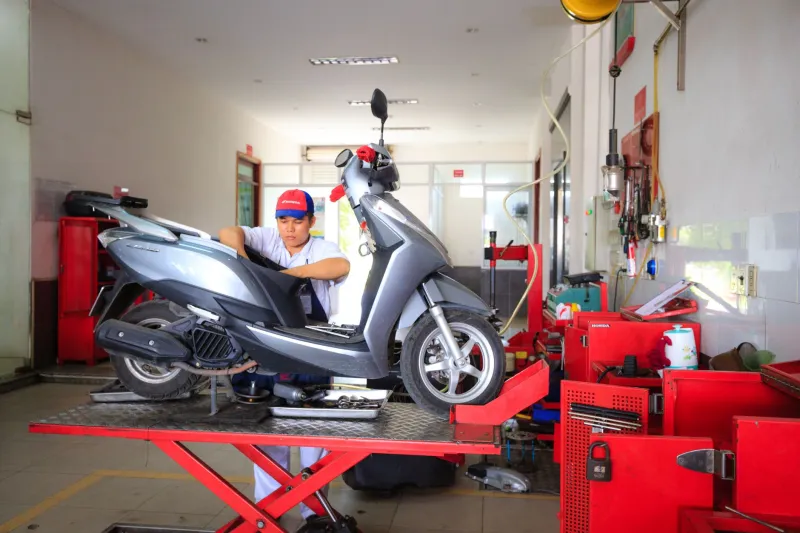
There's a particular kind of silence that settles over a man the moment he realizes he has absolutely no idea what he's doing. Tyler from Denver knows that silence well. He felt it on a Tuesday morning in Duong Dong, crouched beside a semi-conscious Honda Wave, staring at an engine he'd just disassembled and no longer knew how to put back together. The mechanic across from him — a compact, unhurried man named Minh — watched without judgment, then wordlessly reached over and pointed at the piece Tyler had placed in the wrong spot.
That moment, Tyler says, was worth the whole trip.
The Shop at the Edge of the Tourist Map
Phu Quoc gets a lot of press for its beaches, its pepper farms, its pearl operations, and its resort corridors. What it doesn't get much credit for is its informal mechanical culture — the dense web of roadside repair stalls and family-run garages that keep the island's motorbike fleet alive and moving.
Motorbikes are the circulatory system of Phu Quoc. Locals ride them to fish markets at 4 a.m., kids take them to school, vendors load them with impossible quantities of produce. And when those bikes break down — which they do, because the roads here are hard on machines — they end up in the hands of self-taught mechanics who learned their trade not from manuals but from watching, doing, and occasionally catastrophizing.
These shops aren't on any app. They don't have Google reviews. But they're everywhere once you start looking: tucked under tarps at the edge of the road, squeezed between noodle stalls, operating out of what looks, from the outside, like someone's living room — because it often is.
Why Americans Are Stopping In
The trend started organically, the way most good things on Phu Quoc do. A traveler rents a motorbike, something goes wrong, they push it to the nearest shop. The mechanic fixes it in twenty minutes for three dollars. The traveler is fascinated. They linger. They ask questions with their hands. The mechanic answers the same way.
And somehow, from that fumbling exchange, something clicks.
Social media has amplified what used to be purely word-of-mouth. Short videos of Americans learning to patch tires or adjust carburetors alongside Vietnamese mechanics have accumulated quiet but devoted audiences online — not because they're flashy, but because they feel genuinely real. There's no sponsorship energy. No perfectly framed beach in the background. Just two people working on something together, one of whom knows what they're doing.
Some travelers now come specifically for this. They book cheap guesthouses near the island's working neighborhoods, rent the oldest, most unreliable bikes they can find, and spend their mornings at the shop when something inevitably needs attention. A few have stayed for weeks. A handful have stayed for months.
What You Actually Learn
The mechanical knowledge is real and transferable. Former students — if you can call them that, since no one is formally teaching anyone anything — report going home with a working understanding of two-stroke and four-stroke engines, basic carburetor tuning, chain tension, brake adjustment, and electrical troubleshooting. Skills that cost serious money to learn at a stateside vocational program, absorbed here through proximity and repetition.
But the mechanics themselves will tell you that's not really the point. Or at least, it's not the whole point.
Minh, who has been fixing bikes in the same spot for over two decades, says the Americans who stay longest are the ones who stop trying to learn fast. "First week, they want to know everything," he says, through a neighbor who occasionally translates. "After that, they just want to understand one thing well. That's when I can actually help them."
There's a philosophy embedded in that observation that a lot of American travelers find unexpectedly disarming. The U.S. tends to reward speed — fast learning, fast results, fast content. Phu Quoc's repair culture runs on a different clock. You wait for the part. You watch the problem. You don't force the bolt.
The Unspoken Exchange
Language is almost never a barrier, which surprises most people who show up expecting it to be one. Mechanics communicate through demonstration: here's how you hold the wrench, here's the sound a healthy engine makes versus a sick one, here's what this particular rattle means at this particular speed. American visitors who arrive with zero Vietnamese and zero mechanical experience find themselves absorbing both, simultaneously, through their hands.
What flows back in the other direction is harder to quantify but no less real. Mechanics who work with foreign visitors describe a kind of renewed attention to their own craft — having to slow down and explain (even nonverbally) what they've always done instinctively makes them more conscious of their own expertise. A few have mentioned that it's the first time they've thought of what they do as something worth teaching.
For American travelers exhausted by curated experiences — the cooking class with the laminated recipe card, the tour with the earpiece, the "authentic" village that runs on a schedule — there's something almost startling about an interaction that nobody designed. Nobody packaged this. The shop was just there. The mechanic was just working. You just stopped.
How to Find Your Way In
There's no directory for this, and honestly, that's part of why it works. The best approach is the most obvious one: rent a motorbike (the older the better), ride it around the island's less-traveled interior roads, and wait for something to need attention. It will. Then push it to the nearest shop and don't be in a hurry to leave.
Bring a translation app, but don't lean on it too hard. Bring patience, which is harder. Bring some cash to pay fairly for the work — these are working people running small operations, and the transaction should feel mutual, not extractive.
If you want to go more intentionally, guesthouses in the Duong Dong area and around the island's fishing neighborhoods are well-positioned near clusters of repair shops. Ask your host which mechanic they use. That introduction matters more than you'd think.
What You Take Home
Tyler from Denver went back to Colorado with a basic understanding of carburetor float valves, a vocabulary of about forty Vietnamese words, and a photograph of himself and Minh standing next to the fully reassembled Honda Wave, both of them looking moderately proud.
He also went home, he says, with a different relationship to not knowing things. To being a beginner. To sitting with a problem instead of rushing it.
Phu Quoc has a way of offering that — not through a program or a retreat or a carefully marketed experience, but through the simple, generous reality of people who are good at something and willing to let you watch. Sometimes that's all transformation requires: a roadside shop, an unhurried teacher, and an engine that needs fixing.