Merchants, Monsoons, and Coral: How Ancient Trade Winds Are Guiding Phu Quoc's Dive Scene Into New Waters
Most people who book a flight to Phu Quoc are thinking about the water in a pretty specific way: blue, warm, and ideally within stumbling distance of a cocktail. That's fair. The island delivers on all of that without breaking a sweat. But beneath the postcard surface, something far older is waiting — a network of submerged history that's quietly turning this Vietnamese island into one of Southeast Asia's most compelling dive destinations for travelers who want their adventure to mean something.
We're talking about trade routes. Ancient ones. The kind that connected Chinese merchant vessels to Khmer ports, linked Persian spice traders to Gulf of Thailand fishing communities, and funneled goods — ceramics, silk, salted fish, bronze — across open water centuries before any of us were born. Phu Quoc didn't just sit near these routes. It was part of them.
The Island That History Floated Past
To understand why Phu Quoc matters to maritime historians, you have to zoom out on the map. Sitting in the Gulf of Thailand, roughly equidistant between the Vietnamese coast and the Cambodian shoreline, the island was a natural waypoint for vessels navigating between the South China Sea and the Bay of Bengal. Monsoon winds dictated everything about ancient sea travel — which direction you could sail, how long you'd be stuck waiting for the wind to shift, and where you'd anchor to resupply.
Phu Quoc was that kind of place. A shelter stop. A freshwater source. A spot to trade a little cargo, fix a sail, maybe bury a shipmate who didn't survive the crossing.
Archaeologists and maritime researchers have long suspected that the waters around Phu Quoc hold significant remnants of this traffic — ceramic fragments, ship timbers, anchors, and personal cargo that sank during storms or ran aground on reefs that haven't moved in a thousand years. The challenge has always been access. Systematic underwater archaeology in this part of Vietnam is still in its early stages, and what's down there hasn't been fully catalogued. But that's starting to change.
Dive Operators Who Do Their Homework
A handful of dive shops operating out of Phu Quoc's An Thoi district have started positioning themselves differently from the mainstream reef-tour crowd. Rather than competing purely on price or dive site volume, they're partnering — informally in most cases — with local historians, Vietnamese university researchers, and the occasional foreign maritime archaeologist passing through on a grant.
The result is something that feels less like a recreational dive and more like a guided investigation. Operators brief divers on what historical artifacts might look like in this region — thick-walled Chinese stoneware, bronze fittings, the distinctive ballast stone configurations associated with pre-modern merchant vessels — and explain why certain underwater topographies tend to accumulate wreck debris. You're not just watching coral. You're reading the seafloor like a document.
For American travelers, there's an obvious parallel here: it's the difference between a bus tour of Washington D.C. and actually sitting down with a historian who can explain why the layout of the city was designed the way it was. Context changes everything.
What's Actually Down There
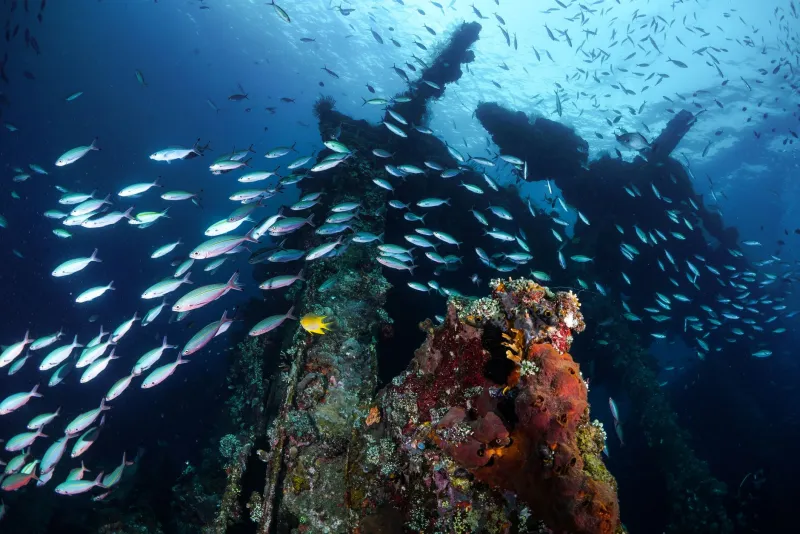
Let's be honest about what divers can realistically expect to find on a guided historical dive around Phu Quoc right now. You're unlikely to stumble across an intact merchant vessel on your first afternoon in the water. The seafloor here has been worked over by fishing nets, storms, and time. Most of what remains is fragmentary — a scatter of ceramic shards here, an anchor chain there, the ghost outline of a hull visible only to someone who knows what they're looking for.
But fragments can be extraordinary. A shard of Song Dynasty celadon pottery sitting on a sandy bottom sixty feet down carries a story that no museum exhibit can quite replicate. You found it. It's been sitting there since before the Mongol invasions reshuffled the political map of Asia. That's not nothing.
Beyond the artifacts, the dive sites themselves carry historical weight. Certain reef formations near the southern tip of the island were documented by French colonial hydrographers in the late 19th century as known hazards — places where ships had been wrecking for as long as anyone could remember. Diving those sites with that knowledge in your head changes the experience entirely.
The American Angle: Why This Matters to You Specifically
Here's something worth sitting with: the United States doesn't have a lot of deep maritime history by global standards. Jamestown was founded in 1607. The trade routes that ran through Phu Quoc were already centuries old by then. For American travelers, that kind of temporal depth is genuinely hard to find at home, and it tends to hit differently when you encounter it abroad.
There's also a growing segment of American adventure travelers — roughly in the 30-to-55 demographic, well-traveled, increasingly skeptical of pure leisure tourism — who want their vacations to involve learning something real. Not a resort-curated cultural performance. Not a staged cooking class. Something with actual intellectual texture. Historical dive tourism in Phu Quoc is a pretty clean answer to that demand.
It doesn't hurt that the diving itself is legitimately good. Water visibility in the dry season (roughly November through April) can reach 20 to 30 meters on a good day. Coral health varies by site but the southern archipelago offers some genuinely impressive hard coral structures. The fish life is solid. Even if the historical framing doesn't hook you, the diving holds up on its own terms.
How to Plan This Kind of Trip
If you want to experience Phu Quoc's historical dive scene rather than just its recreational one, a little pre-trip research goes a long way. Look for operators who advertise specialty dives or who have visible connections to research institutions — a few have started posting about their collaborations on social media, which makes them easier to identify. Reach out before you book and ask directly whether they offer any historically oriented dive briefings or site selections. The response you get will tell you a lot.
Budget at least three to four days for diving if this is your primary interest. The sites that carry the most historical relevance aren't always the most convenient to reach, and weather can shift your schedule. Staying in An Thoi rather than the main tourist strip near Duong Dong puts you closer to the departure points for southern dive sites and generally connects you with a more serious diving crowd.
And bring a notebook. Not for collecting artifacts — those stay where they are, always — but for writing down what the guides tell you. The oral history that local dive operators carry about these waters is, in its own way, as valuable as anything sitting on the seafloor.
The Bigger Picture
Phu Quoc is at an interesting moment. The resort infrastructure has grown fast over the past decade, and the island is navigating the tension between mass tourism and the kind of place it actually is — layered, historically rich, ecologically complex. Historical dive tourism is one of the more elegant ways that tension gets resolved. It brings in travelers who care about preservation, supports operators who invest in knowledge rather than just volume, and frames the island's underwater environment as something worth protecting because it's irreplaceable.
For American travelers considering Vietnam, that framing is worth taking seriously. You can find good beaches in a lot of places. You can't find the Gulf of Thailand's maritime history anywhere else.