Mud, Roots, and Quiet: Why Phu Quoc's Mangroves Are the Wellness Trip You Didn't Know You Needed

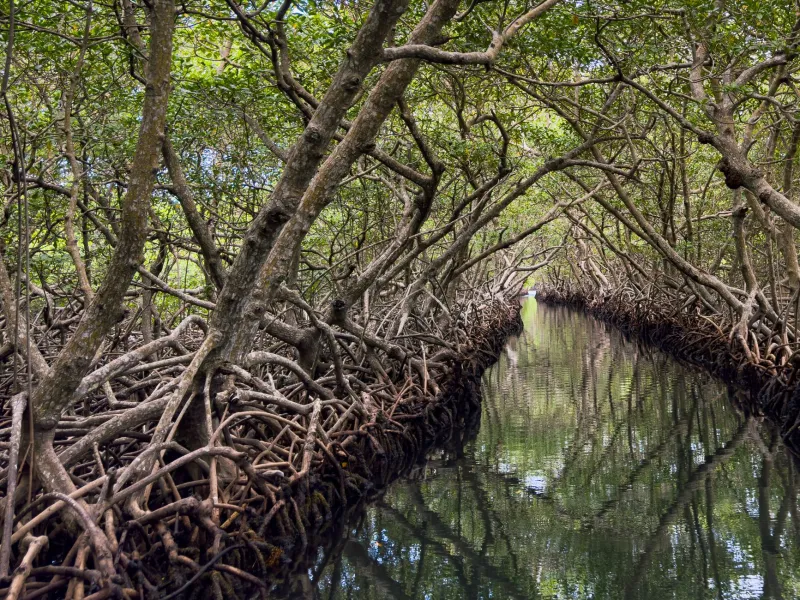
Somewhere between the resort strip and the night market, there's a version of Phu Quoc that doesn't show up on Instagram. No cocktails at golden hour. No hammocks strung between palms. Just the sound of water moving through roots, a paddle dipping in and out of shallow green channels, and the particular kind of silence that makes your nervous system finally exhale.
This is mangrove country. And it's quietly becoming one of the most compelling wellness destinations in Southeast Asia — especially for American travelers who've run out of patience for spas that feel like airports with aromatherapy.
What Forest Bathing Looks Like When the Forest Is Flooded
Most Americans have heard of shinrin-yoku — the Japanese concept of forest bathing, or spending slow, intentional time in wooded environments to reduce cortisol and restore mental clarity. The research behind it is solid: studies from institutions like Stanford and the University of Michigan have linked time in natural settings to measurable drops in stress hormones, improved mood, and better attention spans. What fewer people realize is that wetland ecosystems — mangroves in particular — may offer an even more potent version of this effect.
Mangrove forests are extraordinarily biodiverse. On Phu Quoc's northern and eastern edges, where development hasn't yet reached, these salt-tolerant trees form dense corridors above water that filters through their root systems. The air is thick with negative ions — the same particles found near waterfalls and ocean surf that researchers associate with reduced anxiety. The sounds are layered and alive: birds you can't name, water you can't see the bottom of, the occasional plop of something slipping off a branch.
It's sensory without being overwhelming. And that distinction matters.
The Guides Who Are Making This Happen
Tuyen, a former fisherman from a village near Rach Tram on Phu Quoc's western coast, started leading kayak trips through the mangroves about four years ago. What began as a practical side income — paddling tourists through channels he'd navigated since childhood — gradually evolved into something more intentional.
"The first groups just wanted photos," he says, laughing. "But then I noticed some people didn't want to talk. They just wanted to float. So I started making room for that."
Now Tuyen runs what he loosely calls "quiet kayak sessions" — two to three hours of guided paddling through the mangrove corridors, with built-in stops for stillness. No narration unless guests ask questions. No playlist. Just the ecosystem doing its thing while people sit inside it and decompress.
He's not alone. A small but growing network of local guides around Phu Quoc has started offering similar experiences, some in loose collaboration with eco-lodges, others operating independently through word of mouth. None of them use the phrase "forest bathing" in their marketing — that language hasn't crossed over yet — but the experience they're offering maps almost exactly onto what wellness researchers describe.
Why American Travelers Are Showing Up for This
If you've spent the last few years watching the wellness industry balloon into a $4.5 trillion global market (per the Global Wellness Institute), you've probably also noticed a growing backlash against its more performative corners. Cold plunge influencers. $40 adaptogen lattes. Spa retreats that feel more like luxury hotels with dimmer switches.
A certain kind of American traveler — usually someone who's already done the resort circuit and found it hollow — is actively looking for something else. Something that doesn't require a credit card swipe every twenty minutes and actually makes them feel different when they leave.
Mangrove experiences hit that mark in a way that's hard to fake. You can't Instagram your way through two hours of silent paddling. The mud doesn't care about your wellness brand. The egret perched on a root above your kayak isn't performing for you. And that authenticity — that total indifference of the natural world to your presence — turns out to be exactly what a lot of people are hungry for.
"I came here thinking I'd do a beach vacation," said one traveler from Portland who ended up booking a second mangrove session after her first. "And the beach was fine. But the mangroves were the only time I actually felt like I'd gone somewhere."
What to Know Before You Go
If you want to experience Phu Quoc's mangroves the right way, a few practical notes:
Timing is everything. The best mangrove kayaking happens in the morning, before the heat peaks and before motorized boat traffic increases in nearby channels. Aim for departures between 6:30 and 8:00 a.m. if you can manage it.
Go with a local guide. The channels aren't always well-marked, and some areas are protected. A guide who knows the ecosystem will also know which corridors are quietest, which spots have the most wildlife activity, and how to read the tides so you're not paddling against them.
Leave the itinerary behind. Seriously. The value of this experience is inversely proportional to how much you're trying to optimize it. Resist the urge to photograph everything. Let some of it just happen.
Dress for the environment, not the 'gram. Long sleeves protect against sun and insects. Water shoes or old sneakers beat sandals. You may get muddy. That's fine. That's the point.
Combine it thoughtfully. A mangrove morning pairs well with a slow afternoon — local lunch at a riverside spot, maybe a hammock nap, not another activity. The restoration effect compounds when you don't immediately overwrite it.
The Bigger Picture
There's something worth naming here beyond the personal wellness angle. Mangrove forests are among the most threatened ecosystems on the planet. Vietnam has lost significant portions of its coastal mangroves to aquaculture and development over the past several decades, and Phu Quoc is not immune to those pressures. The fact that tourism dollars are now flowing toward experiences that require the mangroves to remain intact — healthy, biodiverse, undisturbed — creates a real economic argument for protecting them.
The guides leading these sessions are, in their own way, making the case that a living mangrove is worth more than a cleared one. That's not a small thing.
For American travelers trying to figure out how to spend travel money in a way that doesn't leave them feeling vaguely complicit in something, this is one of the cleaner answers available. You pay for an experience that can only exist if the ecosystem survives. The ecosystem survives in part because people keep paying for the experience. It's not a perfect loop, but it's a real one.
The Takeaway
Phu Quoc will keep selling you beach resorts and spa packages, and some of them are genuinely lovely. But if you've been looking for the version of this island that actually changes how you feel — not just where you are — the mangroves are waiting. Quiet, a little muddy, completely indifferent to your stress levels, and somehow exactly what you needed.
Bring water shoes. Leave your phone in your bag for at least the first hour. Let the roots do their work.