Monks, Memory, and the Unwritten Island: Chasing Phu Quoc's Sacred Oral Archives Before They Disappear
Everybody knows the Phu Quoc that shows up in Instagram grids — the white-sand crescents, the overwater bungalows, the sunset cocktails. That version of the island is real, and honestly, it's gorgeous. But there's another Phu Quoc hiding behind the tree line, up cracked laterite roads, past pepper gardens and cashew groves, where the Wi-Fi doesn't reach and the silence has actual weight to it.
That's where the monks live. And that's where the real history of this island is stored — not in a museum, not in a database, but inside the minds of men in their seventies and eighties who learned everything they know by listening.
The Island's Interior Is a Different Country
Most visitors to Phu Quoc never leave the coastal strip. That's understandable. The beaches are legitimately stunning, and the resort infrastructure has gotten seriously impressive over the last decade. But the island's interior — the part that still looks more or less like it did a hundred years ago — rewards the curious in ways the coastline simply can't.
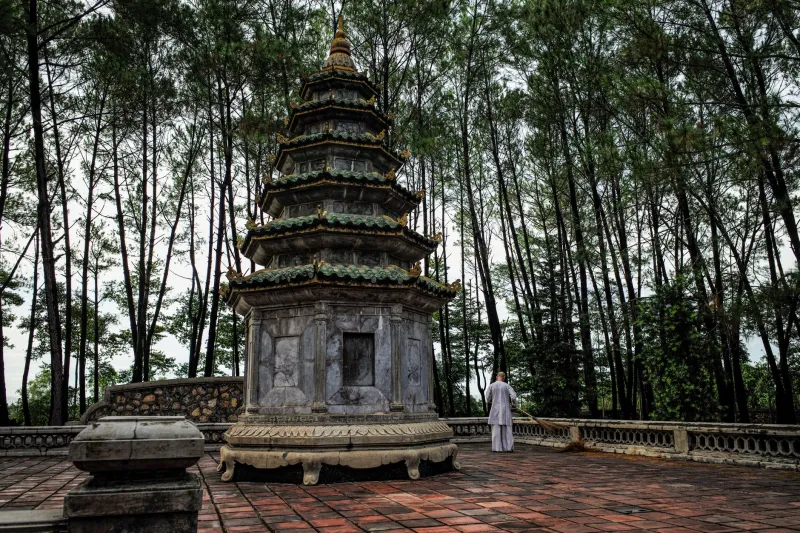
The forest here is dense and layered, full of sounds you can't immediately identify. Small pagodas appear without warning along dirt tracks, their orange-tiled roofs half-swallowed by banyan roots. Some have plaques. Most don't. A few look like they've been sitting in the same spot since before anyone thought to name the surrounding villages.
These aren't tourist sites. There are no admission fees, no gift shops, no laminated maps at the entrance. What they have instead is something considerably rarer: continuity.
What the Monks Are Actually Keeping
I spent three days moving between four of these interior monasteries with a local guide named Minh, who grew up near one of them and still visits on lunar calendar holidays. His presence mattered enormously — not just for translation, but because the monks recognized him. Without that kind of introduction, a foreign visitor would likely receive a polite cup of tea and not much else.
With it, the conversations went somewhere unexpected.
At the first pagoda — a modest compound about forty minutes from Duong Dong on a road that turned from asphalt to gravel to wishful thinking — we sat with a monk named Thầy Phước, who is somewhere in his mid-seventies and has lived at the site for over five decades. He doesn't use a phone. He doesn't need to. What he carries in his memory is staggering.
Thầy Phước recounted the founding genealogies of three fishing villages on the island's southern coast — families who arrived from the mainland in the early nineteenth century, the disputes over fishing grounds that shaped which clans settled where, and the specific rituals those communities developed to mark the transition between monsoon seasons. None of this appears in any guidebook. None of it is on any government heritage register. It exists because he heard it from his teacher, who heard it from his.
That's the thread. And it's fragile.
Oral Tradition as Living Infrastructure
In the United States, we tend to think of history as something that gets written down, filed away, and occasionally digitized. The idea that a culture's most essential knowledge might live exclusively in human memory feels almost abstract — something you'd encounter in an anthropology class, not on a trip you planned on Google Flights.
But that's exactly what's happening in these pagodas. The monks function as what scholars sometimes call "memory keepers" — individuals whose role within a community is explicitly to hold and transmit knowledge that was never meant to be written. In Phu Quoc's case, this includes:
- Village founding stories tied to specific geographic features on the island
- Spiritual practices developed by early fishing communities to negotiate with the sea — rituals that blend Theravada Buddhism with older animist traditions in ways that are entirely local
- Medicinal plant knowledge rooted in the island's specific ecosystem, passed down through monastic lineages
- Oral genealogies connecting present-day island families to mainland origins spanning multiple generations
None of this is secret, exactly. But none of it is accessible, either — not in any way that a traveler, a researcher, or even a curious local could easily find without the right human connection.
Why These Sites Are Disappearing From the Inside Out
The physical pagodas aren't going anywhere. Several have received modest renovation funding in recent years, and the island's growing prosperity has meant that at least the roofs stay intact. The problem isn't structural — it's biological.
The monks who hold these traditions are old. Their students, in many cases, have left for the mainland or for larger urban monasteries with better resources and more novices. The island's rapid economic transformation over the past fifteen years — the casino resorts, the cable car, the international airport — has pulled younger generations toward tourism work and away from monastic life.
Thầy Phước told Minh, and Minh told me, that he has one student currently living at the pagoda. One. The young man is earnest and devoted, but he arrived at the monastery only four years ago. There are stories Thầy Phước carries that would take decades to transmit properly.
The math is uncomfortable.
What a Visit Actually Looks Like — And How to Do It Right
If you're the kind of traveler who wants to seek these places out — and not everyone is, which is fine — there are a few things worth knowing before you go.
You need a local intermediary. Cold-calling a monastery as a foreign visitor is unlikely to produce anything meaningful. Connect with a local guide who has genuine community ties, not just a tourism license. Ask specifically about interior pagodas, and be clear that you're interested in cultural conversation, not sightseeing.
Go slowly and go prepared to receive, not extract. These aren't interviews. They're visits. Bring fruit or incense as a small offering — Minh suggested mangosteens and a bundle of joss sticks, both available at any market in Duong Dong. Sit when invited. Eat when offered. Let the conversation find its own shape.
Learn a few words of Vietnamese. Even a stumbling "Thầy có khỏe không?" — a respectful greeting to a monk — signals that you've made an effort. It matters more than you'd think.
Don't record without asking. And be genuinely prepared for the answer to be no.
The Deeper Reward
Here's what I didn't expect: visiting these pagodas didn't feel like cultural tourism. It felt more like being briefly admitted into the interior life of a place that has been quietly carrying its own weight for a very long time.
Phu Quoc has been sold, understandably, as a paradise — sun, sea, sand, seafood. All of that is true and all of it is worth experiencing. But a place with centuries of human habitation, with fishing communities and trade routes and spiritual lineages, is also something more complicated and more interesting than a beach resort narrative can hold.
The monks in the forest are part of that story. They're keeping it alive the only way it was ever meant to be kept — in the body, in the breath, in the act of one person sitting across from another and saying: this is what happened here, and this is what it meant.
If you can find your way to one of those conversations, even briefly, you'll leave Phu Quoc carrying something that didn't come from a brochure.
And that, for most travelers willing to make the effort, turns out to be the point.